Technical Specifications
This grade family is available as 2 CheMost grades — the differences are in the columns below.
| Property | Unit | T1428 | T1428S | Test Method |
|---|---|---|---|---|
| Appearance | — | Brown red thick liquid | Brown red thick liquid | Visual |
| TBN | mgKOH/g | 28 | 80 | ASTM D2896 |
| Nitrogen | % | 1.25 | 3.2 | ASTM D5762 |
| Viscosity at 100°C | mm²/s | 180 | 480 | ASTM D445 |
| Flash Point | °C | 202 | 210 | ASTM D93 |
| Density at 20°C | kg/m³ | 910 | 940 | ASTM D4052 |
| Color | — | 2.5 | 4.5 | ASTM D1500 |
| Moisture content | % | 0.03 | 0.03 | ASTM D95 |
| Mechanical impurities | % | 0.03 | 0.03 | ASTM D473 |
| Solubility | — | Mineral Group I/II/III, >10% | Mineral Group I/II/III, >10% | — |
* Typical values from batch production. Batch-specific COA available on request.
Technical content reviewed by the CheMost additives team · Specifications last reviewed
Molecular Structure
Interactive 3D Molecular Model
succinimide · Rotate, zoom and inspect 3D conformer
Molecular structure · ashless dispersant
(PIB–succinimidyl)₂ · polyamine bridge
A polyisobutylene-substituted bis-succinimide: two succinimidyl groups joined by a polyamine bridge. The polar imide/amine head adsorbs and disperses soot and sludge, while the oil-soluble PIB tails keep the contaminants suspended away from metal surfaces.
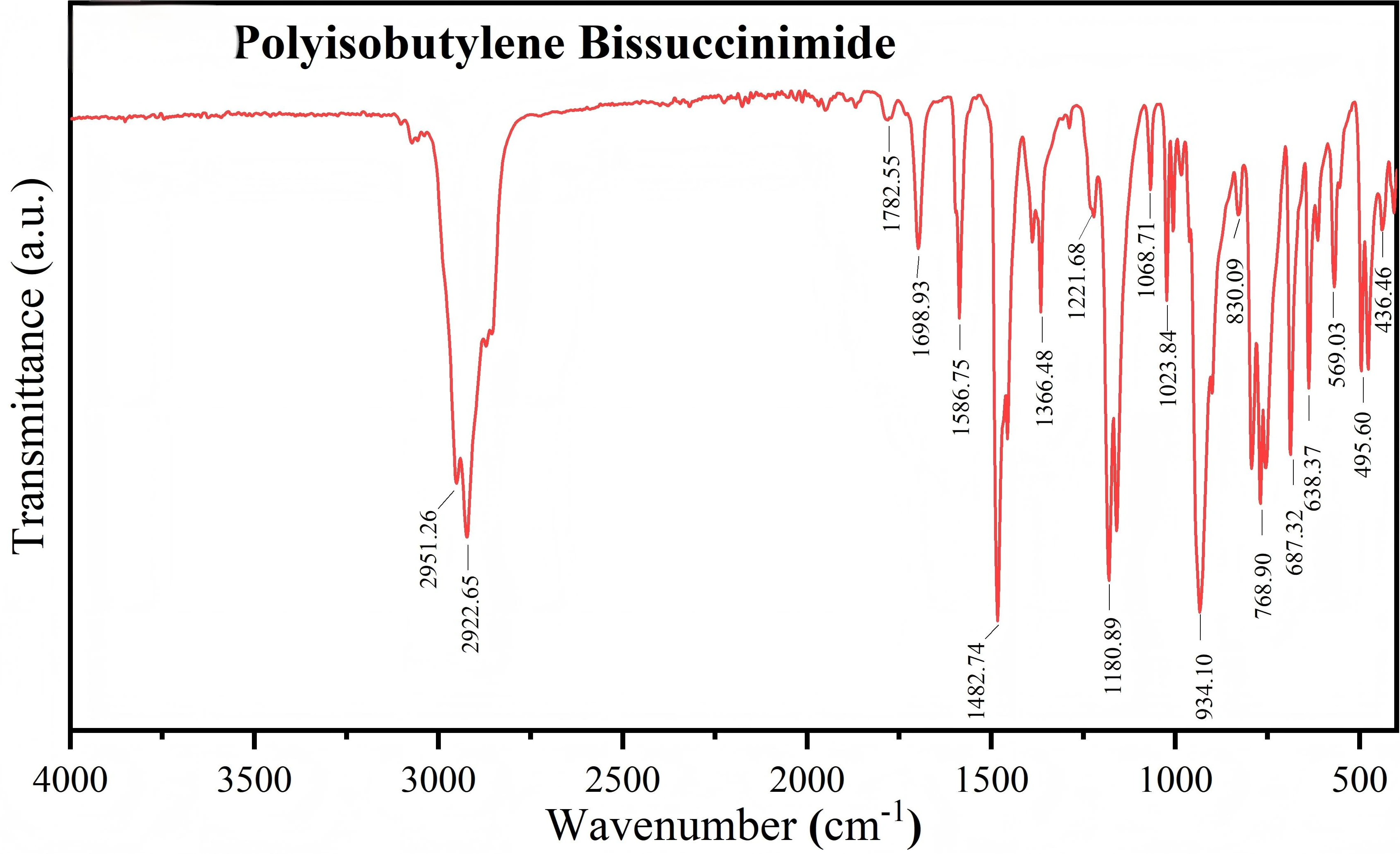
Infrared Spectrum (FTIR)
Fourier-transform infrared (FTIR) spectroscopy records the wavelengths of infrared light a sample transmits and absorbs, producing an absorption pattern tied to its functional groups and bonding. Read alongside the nitrogen and TBN data above, it gives an independent way to confirm batch identity and consistency.
What Is Polyisobutylene Bissuccinimide?
CheMost polyisobutylene bissuccinimide is a chlorine-free, ashless dispersant built from highly reactive polyisobutylene (PIB) carrying two succinimide groups — a bis-substituted structure — joined through a polyamine bridge. Being ashless, it delivers nitrogen-based dispersancy with no metal or sulphated ash, which suits modern low-ash (low-SAPS) formulations.
Whether a succinimide ends up mono– or bis-substituted is set by the PIBSA-to-polyamine ratio: a molar excess of PIB succinic anhydride favours the bis (and tris) structure, giving a balanced, highly oil-soluble dispersant that is the workhorse of crankcase formulating. The polar imide/amine head adsorbs onto soot and deposit precursors while the oil-soluble PIB tail keeps them suspended — controlling deposits, wear and viscosity growth.
CheMost supplies the bissuccinimide in two grades: T1428, the standard balanced grade (TBN 28, 1.25% N), and T1428S, a high-nitrogen “super” grade (TBN 80, 3.2% N) for severe-duty dispersancy. The Technical Specifications above list both grades side by side; the guidance below explains which to choose.
Choosing Between T1428 and T1428S
Both grades are the same chlorine-free PIB bissuccinimide chemistry (full numbers in the Technical Specifications above); they differ in nitrogen and base number, which set how much soot and sludge each unit of dispersant holds. T1428 is the balanced standard grade for general PCMO and HDDEO. T1428S is the high-nitrogen “super” grade — its higher nitrogen packs far more polar dispersancy sites per molecule, so it holds more soot and sludge at a given treat, for high-soot diesel and severe-deposit service. Treat rate is 2.0–4.0 wt% in engine oils and 0.1–2.0 wt% in industrial lubricants for both grades.
The trade-off is general to high-nitrogen dispersants: the higher the nitrogen, the more attention finished-oil fluoroelastomer (seal) compatibility needs. Where a formulation is seal-sensitive, a borated grade is the usual answer — see boron-modified PIB succinimide.
How It Works
Soot & sludge dispersancy
The polar bis-succinimide head adsorbs onto soot and sludge particles and the PIB tail holds them dispersed in the oil — preventing the agglomeration that drives deposits and oil thickening.
High-temperature deposit control
Strong inhibition of high-temperature oil sludge keeps the piston ring-belt and other hot surfaces clean through extended service.
Viscosity-growth control
By keeping soot finely dispersed, the dispersant limits the soot-induced viscosity rise that otherwise impairs oil flow in high-soot diesel engines.
Ashless, high N & TBN
A bis-substituted structure delivers nitrogen-based dispersancy with no metal — and in the T1428S grade, very high nitrogen (3.2%) and TBN (80) — without adding sulphated ash.
Applications
CheMost PIB bissuccinimide is used as the ashless dispersant component in formulations targeting the categories below; the high-nitrogen T1428S is favoured where soot and sludge loads are highest.
Heavy-duty diesel engine oils
Disperses the high soot loads generated by EGR and modern combustion, supporting formulations targeting API CK-4/FA-4 and ACEA E6/E9 against soot-driven wear and viscosity growth. T1428S suits the highest-soot duty.
Passenger-car & gasoline engine oils
Controls low-temperature sludge and varnish from stop-start and short-trip service, supporting cleanliness in oils targeting API SP and ACEA categories.
Industrial lubricants
Provides deposit and sludge control where oxidation by-products would otherwise accumulate.
Finished-oil OEM approvals (e.g. API, ACEA and OEM sequences) are held by the fully formulated oil, not by an individual additive component.
Treat Rate
Typical treat rates from the technical data sheets, by application (the same ranges apply to T1428 and T1428S):
| Application | Treat rate |
|---|---|
| Engine oils | 2.0–4.0 wt% |
| Industrial lubricants | 0.1–2.0 wt% |
For context, the dispersant is typically the largest single additive in an engine oil — around 3–7 wt%, roughly half the additive package. Within that envelope, the high-nitrogen T1428S reaches a target dispersancy at a lower treat than the standard grade, or holds more soot at the same treat; the standard T1428 is the balanced default. The exact level depends on the soot/sludge load, the co-additive package and the target specification.
Treat rates are typical ranges from the TDS, not fixed dosages. CheMost can provide formulation and treat-rate support on request.
Formulating With PIB Bissuccinimide — Complementary Additives
A dispersant covers low-temperature contaminant control; a balanced crankcase package pairs it with additives that cover the rest of the performance envelope:
Detergents & TBN boosters
The dispersant handles low-temperature soot and sludge; overbased detergents neutralise combustion acids and clean hot surfaces. The detergent–dispersant balance is the backbone of every crankcase additive package.
ZDDP antiwear additives
ZDDP adds antiwear protection and secondary antioxidancy. Dispersant and ZDDP treat rates are balanced together, since dispersant can interact with the ZDDP film at metal surfaces.
Antioxidants
Phenolic and aminic antioxidants extend oil life and slow the oxidation that forms sludge — working alongside the dispersant’s deposit control.
Viscosity index improvers
For multigrade oils; dispersant-type VI improvers can complement the bissuccinimide’s soot-handling in high-soot diesel formulations.
The CheMost Ashless Dispersant Family — Mono / Bis / Borated / HMW
Polyisobutylene succinimide dispersants come in four recognised types. Bissuccinimide (this page) is the balanced workhorse; the others trade off nitrogen, molecular weight and boron modification:
| Type | CheMost grade(s) | Distinctive feature | Best for |
|---|---|---|---|
| Monosuccinimide | T1351 | Single succinimide group, high nitrogen (2.1%) | Low-temperature sludge & varnish, gasoline/PCMO |
| Bissuccinimide | T1428 · T1428S | Two succinimide groups; standard & high-N grades | Balanced soot & sludge control, PCMO & HDDEO |
| Boron-modified | T1428B · T1620B | Borated head → antioxidancy, antiwear, seal compatibility | Low-SAPS, GDI/turbo PCMO, seal-sensitive oils |
| High molecular weight | T1620 | Large PIB tail → superior soot dispersancy | High-soot heavy-duty diesel |
Documentation, Qualification & Regulatory Support
Standard documentation — Certificate of Analysis (COA, per shipment), Technical Data Sheet (TDS) and Safety Data Sheet (SDS, GHS/CLP) — is provided. The full TDS is available on request rather than as a public download. Additional support is available on request:
Regulatory documentation
REACH, TSCA and country-specific market-registration documentation support available on request.
Third-party inspection
SGS / Intertek / BV pre-shipment inspection can be arranged on request.
Custom grades & packaging
Custom grades and packaging — metal drum, IBC, ISO tank.
Formulation support
Treat-rate calculation and formulation guidance from our technical team.
Packaging & Supply
CheMost PIB bissuccinimide is stocked and shipped worldwide, with a typical lead time of 1–15 days. Samples and quotations are answered within 12 hours.
Packaging
170 kg metal drum · 900 kg IBC tank.
Minimum order
1 drum or 1 IBC — no minimum order value.
Incoterms
FOB · CIF · EXW, to suit your freight arrangement.
Loading ports
All major Chinese ports.
Frequently Asked Questions
What is polyisobutylene bissuccinimide?
It is an ashless (metal-free) dispersant made by attaching two succinimide groups to highly reactive polyisobutylene through a polyamine bridge, produced by a chlorine-free process. It disperses soot and sludge to control deposits, wear and oil thickening. CheMost offers it as the standard T1428 (TBN 28, 1.25% N) and the high-nitrogen T1428S (TBN 80, 3.2% N).
What is the difference between T1428 and T1428S?
Both are the same PIB bissuccinimide chemistry. T1428 is the standard balanced grade (TBN 28, 1.25% nitrogen); T1428S is a high-nitrogen “super” grade (TBN 80, 3.2% nitrogen) with far more polar dispersancy sites, so it holds more soot and sludge per unit treat for high-soot diesel and severe-deposit duty. Because nitrogen is higher, T1428S’s fluoroelastomer seal compatibility should be confirmed in the finished formulation.
What is the difference between mono- and bissuccinimide dispersants?
A monosuccinimide carries one succinimide group per PIB chain and tends to higher nitrogen and base number (best for low-temperature sludge and diesel soot); a bissuccinimide carries two and is the balanced, highly oil-soluble workhorse for general PCMO and HDDEO. CheMost offers both — see polyisobutylene monosuccinimide (T1351).
What treat rate should I use?
Typical ranges from the TDS are 2.0–4.0 wt% in engine oils and 0.1–2.0 wt% in industrial lubricants for both grades. The dispersant is usually the largest additive in an engine oil (about 3–7 wt%, roughly half the package); the high-nitrogen T1428S reaches a target dispersancy at the lower end of that range. Our technical team can assist with the calculation.
How is it supplied, and how fast can I get a sample?
Both grades are supplied in 170 kg metal drums and 900 kg IBC tanks and shipped worldwide. As a manufacturer and sourcing partner (Est. 2013), CheMost responds to sample and quotation requests within 12 hours.