By Technical Team, CheMost Additives | 14 min read | Last updated: 2025-11-05
Dispersants in Engine Oil
TL;DR — Who This Is For & What You'll Get
For formulators, lubrication engineers, and oil blenders who need to understand dispersant performance under real engine conditions. You'll learn how PIBSI dispersants control soot and sludge at the particle level, why diesel engines demand more dispersancy than gasoline engines, how dispersant depletion affects oil drain interval, and how to select dispersant chemistry by engine type and operating severity.
Key Takeaways
- Dispersants control soot and sludge through steric stabilization: polar head attaches to the particle, PIB tail extends into the oil, preventing particle-to-particle contact
- Diesel engines produce 5–10× more soot per oil-change interval than gasoline engines — bis-succinimide is preferred for high-soot conditions
- Dispersant depletion is the primary limiter of oil drain interval: dispersant molecules become saturated with soot and lose their ability to stabilize new particles
- Treat rate is engine-specific: 1–3% for gasoline PCMO, 4–6% for light-duty diesel, 5–8% for heavy-duty diesel — and the dispersant type (mono, bis, borated) matters as much as the amount
- Used oil analysis (insolubles, viscosity increase, TBN retention) reveals dispersant performance before deposits become visible
Table of Contents (click to expand)
Most discussions of engine oil additives start with the base oil. But when an engine fails from sludge — when the oil pickup screen clogs, when the ring grooves pack with carbon, when the valve deck looks like a tar pit — the root cause is almost always inadequate dispersancy. The base oil didn't fail. The dispersant did.
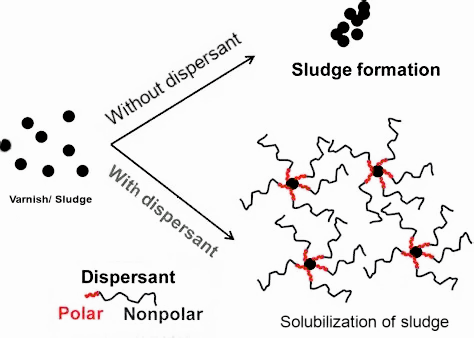
Dispersants are the particle managers of engine oil. Their job is straightforward: grab soot, sludge, and oxidation products, wrap them in an oil-soluble shell, and keep them suspended until the next oil change. When the dispersant system is right, particles stay separated, the oil darkens gradually, and the engine stays clean. When it's wrong — wrong chemistry, wrong treat rate, wrong molecular weight — particles collide, agglomerate, and settle as deposits that reduce oil flow and accelerate wear.
CheMost manufactures PIBSI dispersants — mono, bis, and borated — at 20,000 tons/year. This article is about what those dispersants do inside an engine, and what happens when they can't keep up.
What Dispersants Do Inside an Engine

Combustion blowby introduces soot into the crankcase at a rate of 0.1–0.5 grams per hour in a passenger car and up to 5 grams per hour in a heavy-duty diesel at full load. Diesel soot particles are 20–50 nm primary particles that chain together into fractal aggregates. Left unmanaged, these particles collide and form ever-larger agglomerates — and once they reach about 500 nm, they start settling out of the oil as sludge.
The dispersant molecule — typically a polyisobutylene succinimide (PIBSI) — interrupts this process at the nanometer scale:
1. Polar capture. The succinimide head group adsorbs onto the soot particle surface. The adsorption is strong enough that the dispersant stays attached at 150°C sump temperature and under the shear forces in bearings and ring/liner contacts.
2. Steric barrier. The PIB tail — typically 1,000 molecular weight — extends into the surrounding base oil. Multiple dispersant molecules covering a single soot particle create a dense hydrocarbon "halo" around each particle. This steric barrier prevents particles from approaching each other closer than about 10–15 nm, well above the distance at which van der Waals forces would cause irreversible agglomeration.
3. Oil solubility. The PIB tail dissolves in the base oil, keeping the particle-dispersant complex in suspension. The particle is now "oil-soluble" — it moves with the oil, reaches the oil filter (which traps particles above 10–20 μm), and leaves the engine at the next oil change.
Without this mechanism, soot particles would accumulate at bearing inlets, in ring grooves, and on the underside of the piston crown — locations where oil flow is restricted and deposit formation begins.
Gasoline vs. Diesel: Different Soot, Different Demands

| Factor | Gasoline Engine (PCMO) | Diesel Engine (HDDO) |
|---|---|---|
| Soot production rate | 0.1–0.5 g/h | 1–5 g/h |
| Soot particle size | 10–30 nm (smaller, harder to disperse) | 20–50 nm primary, forms aggregates |
| Primary contaminant | Sludge (soot + oxidized fuel + water) | Dry soot (elemental carbon) |
| Sump temperature | 100–130°C | 110–150°C |
| Oil drain interval | 8,000–15,000 km | 30,000–80,000 km |
| Preferred dispersant | Mono succinimide (T151) | Bis succinimide (T154/T161), often borated |
| Treat rate | 1–5% | 4–8% |
The difference comes down to soot load. A heavy-duty diesel running 50,000 km on a single oil fill accumulates roughly 100–200 grams of soot in the oil — that's 2–4 kg of soot per 100,000 km. A gasoline engine at 10,000 km accumulates 5–15 grams. The diesel needs more dispersant molecules per liter of oil, and those molecules need higher molecular weight (bis-succinimide) to handle the larger aggregate structures that diesel soot forms.
Gasoline direct-injection (GDI) engines are blurring this distinction. GDI engines produce 2–5× more soot than port-injected engines, with smaller primary particles (10–20 nm) that present more surface area per gram of soot. This is why ILSAC GF-6 introduced stricter dispersancy requirements — the standard mono succinimide treat rate of 3–4% in older GF-5 formulations is insufficient for many GDI engines.
Dispersant Depletion: When the Dispersant Runs Out
Dispersant depletion is the primary mechanism that limits oil drain interval. It's not that the dispersant molecules degrade chemically — they don't. They become saturated.
Each dispersant molecule can stabilize only so many square nanometers of particle surface. As soot accumulates, the available dispersant molecules become progressively occupied. When the dispersant-to-soot ratio drops below a critical threshold — roughly 0.05–0.1 grams of dispersant per gram of soot, depending on dispersant molecular weight and the particle size distribution — newly formed soot particles no longer find available dispersant molecules to attach to. They agglomerate. Viscosity increases sharply. Deposits begin forming.
This is why used oil analysis measures insolubles (pentane or toluene insolubles via ASTM D893). When insolubles exceed 3–4% in a diesel engine oil, the dispersant system is approaching saturation. The oil still has TBN. The base oil hasn't oxidized significantly. But the dispersant is full, and the oil needs to be changed.
Signs of dispersant saturation in used oil:
| Indicator | Normal | Warning | Critical |
|---|---|---|---|
| Pentane insolubles | <1.5% | 1.5–3% | >3% |
| Viscosity at 100°C | Within grade | +1–2 cSt above fresh | >+3 cSt above fresh |
| Blotter spot test | Dark center, uniform halo | Center darker, narrow halo | Solid black center, no halo |
| Oil filter delta-P | Normal | Rising trend | Near bypass threshold |
Dispersant Chemistry Selection
| Chemistry | Molecular Weight | Nitrogen % | Soot Capacity | Best Application |
|---|---|---|---|---|
| Mono succinimide (T151) | 3,000–5,000 | 1.0–1.5% | Good | PCMO, light-duty diesel, industrial oils |
| Bis succinimide (T154) | 5,000–8,000 | 1.5–2.0% | Very good | HDDO standard drain (30K–50K km) |
| High-MW bis (T161) | 8,000–12,000 | 2.0–2.5% | Excellent | HDDO extended drain (50K–80K km), marine |
| Borated succinimide | 5,000–10,000 | 1.5–2.5% (+B) | Excellent + anti-oxidant | HDDO extended drain, severe-service gasoline |
| Mono/bis blend | Mixed | 1.2–1.8% | Very good | PCMO GDI, light-duty diesel |
The mono succinimide molecule has one PIB tail and one succinimide head. It's effective and economical — the default choice for passenger car oils at 3–5% treat rate. Bis succinimide has two PIB tails and two heads per molecule, doubling the number of oil-solubilizing chains and increasing the molecular surface area each molecule can cover. For a diesel engine accumulating 150 grams of soot over its oil life, bis provides roughly 40–60% more soot-handling capacity per kilogram of dispersant.
Borated succinimides add a boron atom to the succinimide structure, which provides secondary antioxidant activity. The boron reacts with hydroperoxides (the precursors to oil oxidation), slowing oxidation while the dispersant also controls soot. In extended-drain HDDO formulations, borated dispersants are often used at 20–30% of the total dispersant treat rate — enough to provide oxidation protection without exceeding the boron content limits that some OEM specifications impose.
CheMost's dispersant range includes T151 (mono), T154/T161 (bis), and borated succinimide. All are thermal-process, chlorine-free — which matters because chlorine residues can accelerate corrosion in engines burning high-sulfur fuel.
Dispersants vs. Detergents: They Work Together
A common misconception: dispersants and detergents do the same thing. They don't:
| Dispersants (PIBSI) | Detergents (Ca/Mg Sulfonates) | |
|---|---|---|
| Mechanism | Physical suspension (steric stabilization) | Chemical neutralization + surface cleaning |
| Target | Soot, sludge, varnish precursors | Combustion acids (H₂SO₄, HNO₃), high-temperature deposits |
| Metal content | None (ashless) | Calcium, magnesium (contribute to sulfated ash) |
| Effect on TBN | Minimal (nitrogen-based, ~5–15 mg KOH/g) | Major contributor (TBN 100–400) |
| Location in engine | Throughout the oil — wherever soot travels | Piston ring zone, combustion chamber surfaces |
They're complementary. Detergents clean the hot surfaces where deposits bake on. Dispersants keep the cold sludge-forming particles suspended until they reach the filter or the drain. A formulation with high detergent but low dispersant will have clean pistons and sludge-filled valve decks. The balance matters.
Formulating an engine oil and need dispersant selection guidance? Tell us your engine type, target drain interval, and soot loading → — we'll recommend the right PIBSI grade with treat-rate data.
Frequently Asked Questions
What percentage of engine oil is dispersant?
1–5% by weight in gasoline engine oils, 4–8% in heavy-duty diesel engine oils. The dispersant is typically the second-largest additive component after the detergent in diesel oils, and the largest in gasoline oils.
How do I know if my oil's dispersant is depleted?
Run a blotter spot test on a drop of used oil on filter paper. A healthy dispersant system produces a dark center with a wide, gradually fading halo. A depleted dispersant system produces a sharp-edged spot with little to no halo — the particles aren't being carried outward by the oil. Confirm with pentane insolubles (ASTM D893) — values above 3% indicate saturation.
Can I add more dispersant to used oil?
No. Dispersants are surface-active and compete with other additives (anti-wear, corrosion inhibitor, friction modifier) for metal surface sites. Adding dispersant to used oil shifts the competitive equilibrium unpredictably. If dispersancy is inadequate, the correct fix is a reformulation with higher dispersant treat rate or higher-MW dispersant chemistry — applied to fresh oil, not used.
Why do diesel engines need more dispersant than gasoline engines?
Diesel engines produce 5–10 times more soot per operating hour. The soot particles are larger and form chain-like aggregates that require higher-MW dispersant (bis-succinimide) to stabilize effectively.
Does dispersant type affect oil filter life?
Yes. Insufficient dispersancy allows soot particles to agglomerate into larger particles (0.5–5 μm range) that are more efficiently trapped by the oil filter. This increases filter loading rate and can shorten filter life. Good dispersancy keeps particles in the sub-100 nm range, where they pass through the filter without plugging it.
Are all PIBSI dispersants chlorine-free?
No. CheMost's PIBSI dispersants are made from thermal-process PIBSA and are chlorine-free. Some suppliers use chlorinated-process PIBSA, which can contain residual chlorine. For engines burning high-sulfur fuel, the combination of fuel sulfur acids and chlorine from the dispersant accelerates corrosion. Request a chlorine-content certificate if your application involves sulfur-containing fuel or extended drain intervals. Request chlorine-free PIBSI specifications →
Related Articles
- What Are Dispersant Additives in Engine Oil? — Full dispersant chemistry: PIBSI structure, mono vs. bis, how dispersants differ from detergents.
- What is Polyisobutylene Succinimide (PIBSI)? — The complete PIBSI family overview: mono, bis, and borated chemistry.
- What is Polyisobutylene Mono Succinimide? — T151 dispersant chemistry and applications.
- Ashless Dispersants — Product Category — CheMost's full dispersant product line.
- Detergent Additives in Lubricating Oils — The complementary additive: how detergents work alongside dispersants.
References & Industry Standards
- Machinery Lubrication: The Chemistry of Dispersants in Engine Oil
- STLE: Dispersant Mechanisms in Heavy-Duty Diesel Engine Oils
- ScienceDirect: Polyisobutylene Succinimide Dispersants — Synthesis and Performance
- ASTM International: ASTM D893 — Insolubles in Used Lubricating Oils
Need Dispersant Selection Guidance?
CheMost manufactures PIBSI dispersants — mono (T151), bis (T154/T161), and borated — at 20,000 tons/year in Jinzhou. Our lab provides free dispersancy testing on your base oil. Tell us your engine type and target drain interval, and we'll recommend the right PIBSI grade and treat rate.
Request Dispersant Specifications